 Skip to content
Copper mesh is a metallic mesh material woven from copper wires, possessing properties such as electrical conductivity, thermal conductivity, non-magnetic properties, wear resistance, and corrosion resistance.
Copper mesh is divided into three categories based on its material:
Brass mesh: Contains 65% copper and 35% zinc, with a mesh count of 10-100 meshes per inch, and a width of 0.5-1.5 meters. It is used for particle screening and liquid filtration.
| Mesh/Inch | Wire Diameter (mm) | Aperture (mm) | Mesh/Inch | Wire Diameter (mm) | Aperture (mm) |
|---|---|---|---|---|---|
| 8 | 0.559 | 2.616 | 80 | 0.10 | 0.217 |
| 10 | 0.559 | 1.98 | 90 | 0.09 | 0.19 |
| 12 | 0.457 | 1.66 | 100 | 0.08 | 0.174 |
| 14 | 0.457 | 1.357 | 120 | 0.07 | 0.141 |
| 16 | 0.315 | 1.27 | 140 | 0.07 | 0.111 |
| 18 | 0.315 | 1.096 | 150 | 0.06 | 0.109 |
| 20 | 0.274 | 0.88 | 160 | 0.053 | 0.106 |
| 30 | 0.234 | 0.613 | 180 | 0.053 | 0.09 |
| 40 | 0.152 | 0.485 | 200 | 0.053 | 0.07 |
| 50 | 0.132 | 0.378 | 250 | 0.04 | 0.06 |
| 60 | 0.12 | 0.303 | 300 | 0.04 | 0.05 |
| 70 | 0.11 | 0.253 | 325 | 0.035 | 0.04 |
Copper mesh: Purity ≥99.8%, mesh size 4-60 mesh/inch, width 0.76-1.2 meters, suitable for electromagnetic shielding and electron beam filtering.
Phosphor bronze mesh: Contains 5%-15% tin, with a mesh count of up to 400 meshes per inch, and a width of 1 meter. It is used for corrosion-resistant gas filtration and ceramic printing.
| Matériau | Mesh (Count) | Wire Diameter (mm) | Aperture (mm) |
|---|---|---|---|
| Red Copper | 10 | 0.61 | 1.93 |
| Red Copper | 16 | 0.315 | 1.27 |
| Red Copper | 18 | 0.315 | 1.10 |
| Red Copper | 22 | 0.37 | 0.78 |
| Red Copper | 24 | 0.27 | 0.78 |
| Red Copper | 30 | 0.23 | 0.61 |
| Red Copper | 40 | 0.19 | 0.44 |
| Red Copper | 60 | 0.122 | 0.30 |
| Phosphor Bronze | 60 | 0.15 | 0.27 |
| Phosphor Bronze | 100 | 0.091 | 0.163 |
| Phosphor Bronze | 180 | 0.051 | 0.08 |
| Phosphor Bronze | 250 | 0.041 | 0.061 |
| Phosphor Bronze | 280 | 0.035 | 0.056 |
| Phosphor Bronze | 320 | 0.031 | 0.048 |
| Phosphor Bronze | 360 | 0.031 | 0.039 |
| Phosphor Bronze | 400 | 0.025 | 0.038 |
Based on the different production methods, they are mainly divided into the following types:
Copper braided mesh:

Copper embossed mesh:

Copper expanded metal mesh (copper mesh):
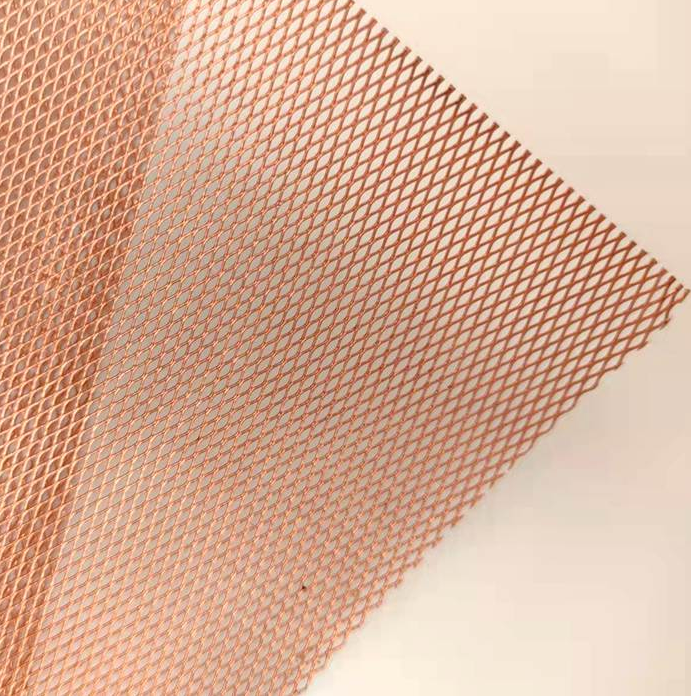
Copper knitted mesh (gas-liquid mesh):
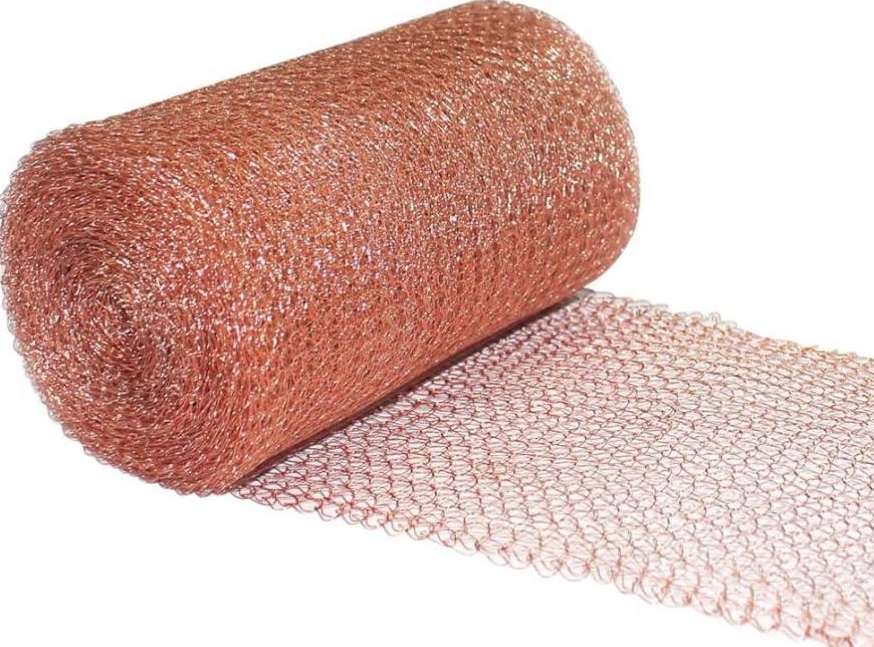
Copper chain link fence:

Main application areas
1. Industrial Applications
• Electromagnetic shielding: Used in electronic equipment and cable shielding layers to prevent electromagnetic interference.
• Filtration and separation: Used as a filter screen for gases and liquids (e.g., in petrochemical and environmental protection equipment).
• Battery electrodes: Some batteries use copper mesh as a current collector.
2. Scientific Research and Experiments
• Experimental equipment: such as catalytic nets and heating nets in chemical experiments.
• Microscope grids: sample support grids for transmission electron microscopes (TEM).
3. Medical and Environmental Protection
• Antibacterial materials: used on the surface of medical equipment and in water filters.
• Wastewater treatment: used as electrolytic or filtration materials.
4. Heat Dissipation Equipment
• Heat sinks, heat exchangers: utilizing high thermal conductivity to improve heat dissipation efficiency.
