 Zum Inhalt springen
- What is duplex stainless steel and what are its characteristics?
The secret of duplex stainless steel lies in its unique “dual-phase” structure. This material has approximately 50% ferrite phase and 50% austenite phase in its solid solution structure. For a typical duplex stainless steel, the content of the less abundant phase must reach at least 30% in stainless steel.
This type of steel combines the characteristics of both austenitic and ferritic stainless steel. It possesses the excellent thoughness and weldability of austenitic stainless steel as wll as the higher strength and better resistance to chloride stress corrosion of ferritic stainless steel. Chemically, this kinds of steel typically has a low carbon content with chromium (Cr) ranging from 18% to 28% and nickel (Ni) from 3% to 10%. To optimize its performance, alloying elements such as molybdenum (Mo). Copper (Cu), Niobiym (Nb), Titanium(Ti), and nitrogen(N) are also added.
But Duplex stainless Steel material also have many disadvantage.
- Compared with austenitic stainless steel :
(1). It is universality and verstaility in application are not as good as austenitic stainless steel.And its heat resistance is lower. Its usage temperature must be controlled under 300℃
(2). Its toughness are lower than austenitic stainless steel. There is a middle temperature brittleness zone, and the heat treatment and welding process systems need to be strictly controlled to avoid the appearance of harmful phases and damage to performance.
- Compered with ferritic stainless steel, the weakness of duplex stainless steel are as follows: high alloying elements, price is relatively high.Generally ferritic stainless steel do not contain Nickel.
- Grades of Duplex Steel and Their Typical Applications
Classification and Characteristics Representative Brand Name Standard Name Main Features and Typical Applications Economic / Low-alloy Type S32304 – Without molybdenum, it has a low cost and can be used as an alternative to 304/316 in mild corrosive environments, such as chemical transport ships. Standard Type S31803 2205, F51, 1.4462 Common brand names. Its corrosion resistance is superior to SS316L and it is used in industries such as chemical engineering, petrochemicals, and seawater treatment. Standard Type S32205 F44 Compared with S31803, the control of chemical composition range is even stricter, providing more stable performance. High Alloy Type / Super Duplex Steel S32750 2507, F53, 1.4410 Contains high levels of molybdenum and nitrogen, offering excellent corrosion resistance and extremely high strength. Used in demanding environments such as seawater desalination and offshore oil and gas operations. High Alloy Type / Super Duplex Steel S32760 F55, 1.4501 Adding copper and tungsten enhances resistance to various forms of corrosion, suitable for strong acid environments. High Alloy Type / Super Duplex Steel S32550 – A type of super duplex steel with high strength, suitable for high-load and corrosive working conditions.
- Weaving Type
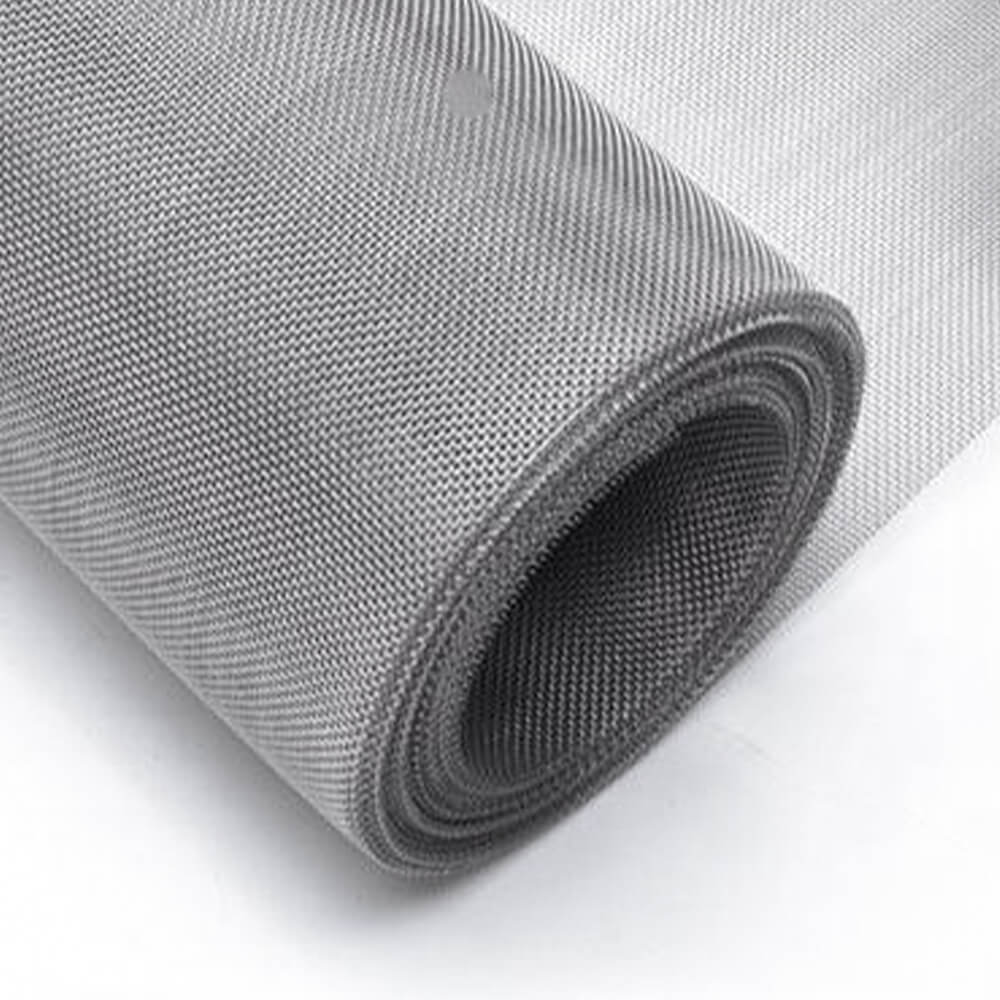
The performance of duplex stainless steel mesh is not dependent on the material itself, but also closely related to the weaving method. The common weaving types mainly include the following :
Plain weave: Plain weaving is the most basic weaving method. Each warp yarn crossed over and under each weft yarn, with the thickness of the warp yarn and weft yarn being the same, and the wrap and weft yarns are arranged at a 90-degree right angle. The structure is uniform and stable, and is suitable for most general filtration scenarios.

The twill weave is more complex. Each warp yarn crosses over and under every 2 weft yarns, and each weft yarn also crosses over and under every 2 warp yarns. This structure enhances the strength and stability of the net, making it suitable for more demanding filtration environments.
The sheet weave (Dutch net) has unique structural characteristics. The diameters of the warp and weft yarns are different, and the counts are also different. Usually, the warp is thinner and the weft is thicker. In the length direction, it is the warp yarns, and in the width direction, it is the weft yarns.
This weaving method can be divided into two types: plain weave Dutch weaving and twill Dutch weaving, which can provide a more refined filtering effect.


- Applications:
Based on the duplex stainless steel wire mesh, we can make flat filter mesh, sintered mesh, or process them into various-shaped filter elements, etc. These filter mesh and filter elements can be widely applied in the following environments.
In the chemical and petrochemical industries, duplex stainless steel wire mesh and duplex stainless steel filters are especially suitable for filtering environments containing chloride ions, sulfides, and other corrosive media. They often appear in pressure vessels, high-pressure storage tanks, heat exchangers, and pipeline systems.
In the marine and seawater treatment fields, duplex stainless steel mesh and filters made by them are widely used in heat exchanger tubes of offshore oil platforms, high-pressure pipes of seawater desalination equipment, and seawater treatment systems.
The energy and environmental protection industries also provide a broad stage for duplex stainless steel mesh. They are used in flue gas desulfurization systems (FGD systems), industrial cleaning systems, and wastewater treatment equipment.
The paper and pulp industry uses duplex stainless steel mesh as classifiers, bleaching equipment, and components of storage and processing systems. This industry requires corrosion-resistant, wear-resistant, and not easily clogged by fibers filtering materials.
In the mining and mineral processing fields, duplex stainless steel mesh is used for screening and filtering various ores and minerals, especially in scenarios where corrosion is prone to occur in coastal humid industrial environments.
- How to Select Materials
When choosing materials, we need to balance factors such as corrosion resistance, strength, and cost based on the specific usage environment.
General corrosion-resistant structural components: Firstly, standard 2205 is highly cost-effective.
However, for harsh environments such as high temperatures sea water and high concentrations of chloride, super duplex steel like 2507 should be selected.
For cost-sensitive non-critical components, the economical S32304 can be considered.
